
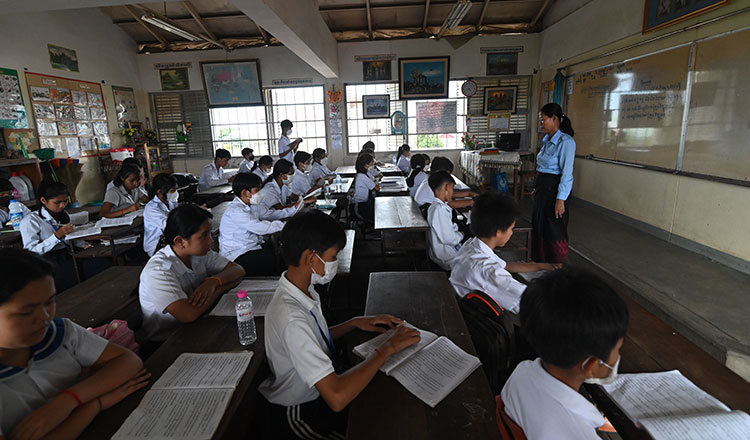
While Cambodia has made progress in expanding education access over the past two decades, low public investment, teacher shortages, overcrowded classrooms and weak governance continue to prevent students from achieving stronger learning outcomes, the World Bank said in a report.
The report, “Cambodia: Addressing Public Finance and Human Resource Bottlenecks to Education Outcomes”, found that while enrolment rates have increased across all education levels, many Cambodian students lack basic literacy and numeracy skills needed for higher education and the workforce.
The World Bank noted that Cambodia’s net enrolment rate in primary education rose from 84% in 2001 to 97.2% in 2024. Lower-secondary enrolment increased from 17% to 75.2%, while upper-secondary enrolment climbed from 8% to 44.3% during the same period. Girls now outnumber boys in secondary education.
Despite these achievements, learning outcomes remain weak. According to the report, Grade 6 students answered fewer than 52% of Khmer language questions correctly and under 50% of mathematics questions in the 2021 National Learning Assessment. Although results from the Southeast Asia Primary Learning Metrics (SEA-PLM) 2024 showed improvements compared to 2019, Cambodia trails regional peers such as Vietnam and Malaysia.
The report attributes the problem to limited public financing for education.
Education spending increased from 1.6% of gross domestic product (GDP) in 2011 to 2.2% in 2022, but the World Bank said this remains lower than spending levels in neighbouring countries and nations with similar income levels. Around 70% to 80% of education expenditure is devoted to salaries, leaving little room for investments in learning materials, infrastructure, teacher development and other programmes.
The report also highlighted Cambodia’s heavy reliance on household spending to finance education.
Families account for approximately 59% of total education spending—well above the average for lower-middle-income countries (39%) and upper-middle-income countries (30%). Even students attending public schools rely on household contributions for school supplies and private tutoring, indicating that families are filling gaps left by insufficient public funding.
The World Bank identified six bottlenecks that hinder improvements in education outcomes.
The first is limited access to early childhood education. Cambodia has the region’s lowest preschool attendance rate, with only one-third of children demonstrating school-readiness skills, compared with 58% in Vietnam. The report cited inadequate funding, fragmented budgeting and a shortage of qualified preschool teachers as challenges.
Secondly, the report said teachers are not receiving sufficient training to perform effectively despite improvements in teacher qualifications.
Nearly one-fifth of Cambodia’s teaching workforce consists of contract teachers with minimal training. Many teachers work half-days while taking secondary jobs to supplement their income, weakening classroom instruction and accountability. Rural schools face teacher shortages while urban schools are often overstaffed.
A third challenge is the lack of effective remedial education for struggling students.
Although the Ministry of Education, Youth and Sport has introduced guidelines for supporting slower learners, implementation remains weak because of limited funding, inadequate teaching materials and insufficient teacher support. The report noted that many classrooms contain students with differing ability levels, making it difficult for teachers to meet individual learning needs.
Large class sizes compound the problem. More than 75% of primary school students study in classes with over 30 pupils, while nearly one-third are in classrooms exceeding 40 students. The report found that learning outcomes deteriorate as class sizes increase, particularly when they exceed 50 students. Cambodia currently faces a shortage of more than 16,000 classrooms.
The World Bank also pointed out shortages of textbooks, inadequate school facilities, and weak school management.
Many schools, particularly in rural areas, lack textbooks, clean drinking water and separate toilets for boys and girls. Meanwhile, limited operating budgets and rigid financial rules make it difficult for schools to purchase learning materials or respond to needs.
Finally, the report said Cambodia’s education management systems remain fragmented.
Separate databases for human resources, finance, student records and school information operate independently with limited integration, reducing the government’s ability to make evidence-based decisions, allocate teachers and monitor education performance.
To address these challenges, the World Bank called for a reform agenda centred on increasing public investment in education while improving the efficiency of public financial management and human resource management.
The report recommends spending on cost-effective interventions that improve learning outcomes, alongside reforms to strengthen teacher management, modernise education information systems, improve school financing and enhance the quality of education service delivery nationwide.
“To address these issues, the report calls for a comprehensive reform agenda that prioritises increases in public spending to support cost-effective interventions for near- and long-term gains,” it reads.
“This includes improving ECE, establishing and expanding childcare services for children under three, improving teacher quality, and ensuring equitable access to learning materials and safe school environments.”
The increases in spending, the World Bank researchers said, must come with governance reforms that improve the efficiency and effectiveness of service delivery mechanisms. They include better planning, budgeting, and data management systems.
“Implementing these reforms in a coordinated and sequenced manner is essential for improving child development education outcomes and achieving Cambodia’s broader development aspirations,” the report adds.
Cambodia’s 2026 national budget allocates 4.474 trillion riel (about $1.1 billion) to the education sector. This amount is part of the country’s overall $10.2 billion national spending plan.
Speaking in a lecture last month, Minister of Education Hang Chuon Naron said that since the launch of education reforms in 2014, the country’s education sector has made progress. In particular, stricter management of secondary school examinations has helped eliminate cheating and encouraged students to focus on learning and academic achievement.
“Successful reform requires identifying key areas that can drive positive change and continuously introducing innovations rather than repeating the same approaches year after year,” he said. “Reforms must respond to evolving social, global and technological developments.”
 2464.386 SRY